Free Cisco Written Dumps
For Top 50 Purchases 01:59:56
X

CCIE Routing and Switching LAB Dumps
Exam Code: CFG: LAB1、LAB1+、LAB2、LAB2+、LAB3
TS: TS1(5 sets)、TS2(3 sets)
DIAG:DIAG 1~DIAG 8(8 sets)
Certification Provider: Cisco
Certification Exam Name:CCIE Routing and Switching Lab
Update Date: Sep 16,2026
Latest Dumps
Numbers of Question & Answers
Numbers of Question & Answers
ccie security lab schedule
Here is the most accurate CISCO CCIE WRITTEN exam questions and answers. All study materials need to be carefully selected by professional certification experts to ensure that you spend the least amount of money, time, and pass the high quality exam. There is also a professional service team that can customize your study plan for you to answer all your questions, PASSHOT's CCIE Written Dumps is definitely the biggest boost for you to test CCIE that helping you pass any Cisco exam at one time.
- 3387 Reviews
ccie security lab schedule
analysis 1.CONSOLE PORT ( management console interface ): distance limit , exclusive way . R14(config)#interface bri 0 Vlan division: 1, based on port; 2, based on MAC address; 3, based on IP address OSPF open protocol , is link-state type routing protocol . Show interface ethernet 0/1 The SSL/TLS protocol works on top of the transport layer (TCP/IP) but below the application layer. Therefore, it can be easily implemented on application layer protocols such as HTTP, Telnet, POP3,ccie security lab schedule, IMAP4, SMTP and FTP. There are at least two different initialization methods for SSL security extensions: explicit security and implicit security. Cisco ASA Adaptive Security Appliance Licensing Requirements Enable "diagnostic mode"? y/n [n]: n (select no) Configuring and Verifying Redundant Interfaces The content, currently in development, may include real-world applications that involve: establishment and examination of the sp lab is a process from scratch. Check to see RouterID and OSPF process ID and related network type . Network Access Layer: Provides an interface to the physical network. For the structure of the transmission medium setting data, the addressing of the data is realized according to the physical address of the hardware, and the error control of the data transmission in the physical network is provided. =========================================================== ================ IPV6 - R - IPV4 - R - IPV6 dual stack router R6(config)#interface ethernet 0 Use the appropriate algorithm , such as (SPF) to calculate the best route trigger update Use multicast to route notifications ( reliable ) Address Resolution Protocol (ARP): A protocol that resolves a logical IP address to a physical address. Loose URPF: Only the routing table of the router is required to have the source address of the packet. The inbound interface of the packet is the same as the outgoing interface of the routing address to the source address. A loose URPF check can be configured when the inbound interface of the user network cannot ensure that the inbound interface of the packet is the same as that of the outbound interface.
Demo1:
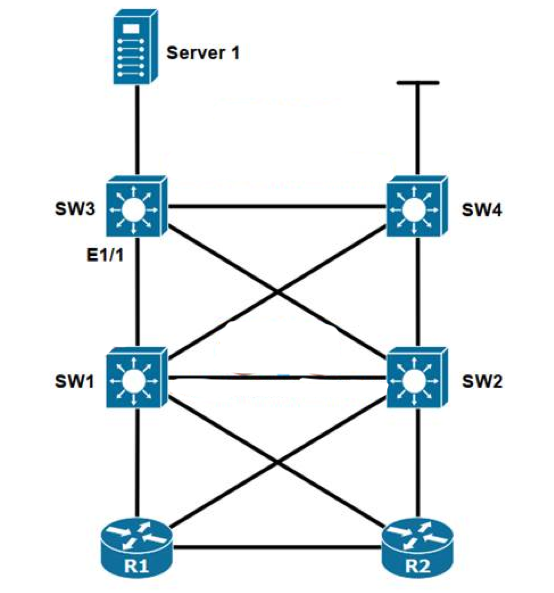
Problem:Server 1 can not get ip address.
Materials:
SW3#show ip dhcp snooping
Switch DHCP snooping is enabled
DHCP snooping is configured on following VLANs:
none
DHCP snooping is operational on following VLANs:
none
Smartlog is configured on following VLANs:
none
Smartlog is operational on following VLANs:
none
DHCP snooping is configured on the following L3 Interfaces:
Insertion of option 82 is enabled
circuit-id default format: vlan-mod-port
remote-id: 0018.b9da.5300 (MAC)
Option 82 on untrusted port is not allowed
Verification of hwaddr field is enabled
Verification of giaddr field is enabled
DHCP snooping trust/rate is configured on the following Interfaces:
Interface Trusted Allow option Rate limit (pps)
-------------------- ------- ------------ ----------------
Q1:Which material is most helpful
Q2:which packets can help you find the cause
Demo2:
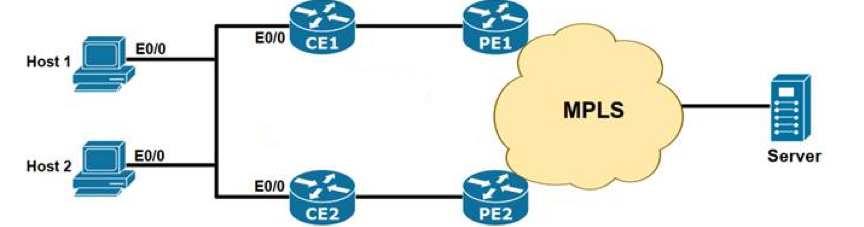
Customer just setup a IPv6 Network, with HSRPv6 on R1 & R2. After setting up, all hosts lose connection.
What would you recommend to your L1 Engineer as a Quick Fix?
CE1 key configuration
standby 1 priority 200
standby 1 preempt
ipv6 nd router-preference low
CE2 key configuration
standby 1 preempt
ipv6 nd router-preference high
I think it is a rouge device because I don't see any problems with the HSRPv6 config. PCs are configured with "ipv6 enable", "ipv6 autoconfig"
The R1 have a "ipv6 nd-preference high" and R2 have "low" if I'm not wrong.
How fast fix the problem?
¡ Shutdown the link between CE2 and PE2.
¡ Shutdown the link between CE1 and PE1.
¡ Configure CE1 with highest HSRPv6 Priority.
¡ Configure CE2 with highest HSRPv6 pirority.
¡ Configure CE2 with low HSRPv6 priority.
¡ Shutdown CE1 interface e0/0.
¡ Shutdown PE2 interface e0/0.
¡ Disable fast-switching on CE's LAN.
¡ Enable fast-switching on CE's LAN.
¡ Change HSRPv1 to HSRPv2 version
RELATED PRODUCTS